Friday, February 3, 2023

Why I left Twitter and went to Mastodon.

There are a few reasons. The first reason is Twitter has such an angry algorithm. Whenever you log in a Twitter you see a tweet by some angry person. Someone I have never heard of before. Twitter’s algorithm promotes speech that elicits responses both negative and positive. Anything that’s controversial moves up on your Twitter feed because of the algorithm. 


Another reason why I like Mastodon is that you are able to label certain posts as sensitive information or disturbing content. On Twitter it’s all just in your face. It’s not that way on Mastodon. Due to the majority of my social media time is now dedicated to Mastodon, I’ve not seen the video of the Memphis Murder. And I don't want to. 


Everyone on Mastodon has been completely nice and sane. When people would respond to me directly on Twitter, I would get a little “gun shy“ before I saw their tweet. I automatically assumed it was going to be something negative or an upsetting response to what I wrote. Often times it was. So far, direct mentions in Mastodon have been to keep the conversation going or to seek information. Not to annoy. 


Mastodon is also open source. No one can own it. It’s created by the people and for the people and is free. This has some good implications for its users. Third party applications that aggregate data and improve user experiences are more easily created since the code is open to all, specifically developers. Twitter just started “pulling the rug out from under some developers.” Things like Twitterific, Fenix and Twitterbot have all had their applications cut off at Twitter without much of an explanation. 


I also can’t support Twitter anymore. There are just too many people spreading lies. Lies that can actually hurt people and Twitter is doing nothing to police these lies now that has new ownership.


I’m not saying that Mastodon is not like Twitter; they are very similar. I’m also not saying that the things I dislike about Twitter won’t happen to Mastodon. For now, I need a timely, diverse and responsive personal learning network for my own growth. So, for now, Mastodon is that tool. 

Friday, January 27, 2023

Education as We Know it is Over


During my time on this earth, I have witnessed some watershed moments in educational technology. One of those moments was when I first discovered a computer. I was in high school. This computer ran from reel-to-reel magnetic tape. There was a lunar landing program, and every time you wanted to play the game and land the lunar vehicle, you had to reload the tape. This became very annoying. I remember only playing the game a few times. This was my first exposure to computers. Eventually, this computer evolved to take cassette tapes.


When I was a kid, my dad bought us an odyssey game console. He bought us this because he felt it was more educational than Atari. Of course, I felt left out. All my friends had Ataris. 


For my first master's degree at Boise State University, my whole Internet connection was through dial-up. It was a degree in educational technology, and it was entirely online. I have never been to Boise, Idaho.


I remember when Alexa first came out. I know Principals and Teachers who wanted to put Alexa in their classrooms so that Teachers would have an auditory connection with the outside world. My argument was that the classroom should be “controlled chaos” and be the type of environment where Alexa does not work very well. Plus, there are all kinds of security concerns with devices that are always listening. 


Another watershed moment was when Twitter was first invented. It was now possible to have instant communication with someone around the world about any topic you wanted to. It was limited to 140 characters at first. This was before hashtags were even invented.  


Another watershed moment was when the education world found out about ChatGPT. With the creation of ChatGPT the idea of artificial intelligence and machine learning became available on a website. The idea of AI (Artificial Intelligence) and ML (Machine Learning) became less abstract to those of us in the education world. We knew previously that artificial intelligence and machine learning were important, but we did not have a tangible way of seeing how AI and machine learning could affect our craft. Now we do.


When students have access to these things, the teacher is no longer the smartest thing in the room. If you know how to ask the right questions, information is even closer than our fingertips. 


Is this really a watershed moment? Or just a natural outcome of progress in educational technology or just technology in general? Are we preparing students to work in AI and ML? How should teachers change what they are doing knowing that an AI and ML future exists? 

You get out of education what you put into it. There will always be students who cheat. And we know eventually they are only cheating themselves. And that is the way we should treat ChatGPT. Blocking ChatGPT is not the answer. Below is a teacher who is using ChatGPT in her classroom.


@gibsonishere It has begun! #tiktokteachers #chatgpt #aitok #tyfdtgw #teachertiktok #educator #aibotok #technology ♬ original sound - Gibson is the name!

Friday, January 20, 2023

Is AI and Machine Learning a "Watershed" Moment in Edtech?


Artificial intelligence (AI) and machine learning (ML) are rapidly becoming integral parts of the global economy, creating a high demand for professionals with the skills and knowledge to work in these fields. There are just not enough skilled workers in these fields. Many students are not adequately prepared to enter these fields due to a lack of relevant education and training. In order to ensure that students are well-equipped to succeed in the AI and ML industries, teachers must adjust their teaching methods to better align with the skills and knowledge required for these fields. 


First, teachers should place a greater emphasis on math and computer science. These subjects are essential for understanding the underlying principles and algorithms of AI and ML. Students should be exposed to a wide range of mathematical concepts, including calculus, linear algebra, and statistics. They should also have a strong foundation in computer science, including programming languages such as Python, as well as data structures and algorithms. 


Second, teachers should incorporate hands-on, project-based learning into their curriculum. This approach allows students to apply the concepts they have learned to real-world problems, which is essential for developing practical skills in AI and ML. For example, students could work on projects that involve building and training their own machine learning models, or using AI to solve a specific problem in a particular industry. 


Third, teachers should encourage students to engage in self-directed learning and experimentation. The field of AI and ML is constantly evolving, and it is important for students to have the ability to learn and adapt as new technologies and techniques become available. Teachers can facilitate this by providing students with resources and support for pursuing their own interests in AI and ML, such as online tutorials and open-source software.


Fourth, teachers should ensure that students are exposed to a diverse range of applications of AI and ML. While the technology is often associated with cutting-edge research in the tech industry, it has a wide range of applications across many different sectors, such as healthcare, finance, and transportation. By exposing students to these different applications, teachers can help them understand the potential of AI and ML and how it could impact different industries, and help them to find where they would like to fit in. 


Finally, teachers should encourage students to think critically about the ethical and societal implications of AI and ML. As these technologies continue to advance, it is important for students to understand the potential risks and benefits, as well as the ethical considerations involved in their development and use. Teachers can facilitate this by incorporating discussions and debates on these topics into their curriculum, and encouraging students to think critically about the impact of AI and ML on society. 


At the very least, artificial intelligence and machine learning may be a “watershed’ moment in educational technology, which causes teachers to be introspective. Every teacher should think about what students should be learning in a world where AI and ML exist.  

Monday, January 9, 2023

Rich Conversations about Education (Again)


I recently joined Mastodon and blurted out a toot. On Mastodon they are called "toots." On Twitter they are called "tweets."

Let me clarify the second part of the toot concerning reading. Basically, all of us do not read as intently as we should. I am guilty of just “clicking agree,” and not reading the entire statement. Typically, when I can’t do something on a website, it’s because I skipped over reading something important. 


My toot elicited some great responses

Now, Don Watkins are pretty good friend and he was the one who suggested Mastodon to me. Don and I have lunch together about once-a-month.


It took a bit longer for Will Richardson to chime in. CABOCES had Will Richardson to our schools about 14 years ago. Web 2.0 had just come to fruition. All of us were learning about Blogs, Wikis, and RSS feeds. Many of which are technologies that I use everyday. Will Richardson is a writer and the act of writing requires one to really think about what they are going to say. Here is Will’s response. 


I would love to know your thoughts on this. Do schools "make space for real professional development?"


Sunday, April 10, 2016

I can admit when I make a mistake.


I'm a Facebook user. I love to look back at my memories from years past. Today one popped up and it was about a project I did in a school district. The year the project occurred was 2009 and I'm not sure the project had any educational benefits.

I think it's important for any educator to look back at lessons that they've done or projects and judge their value. If we as a Educators are lifelong learners, what we knew yesterday is not the same as what we know today. It is possible that what we taught was not a meaningful learning experience.

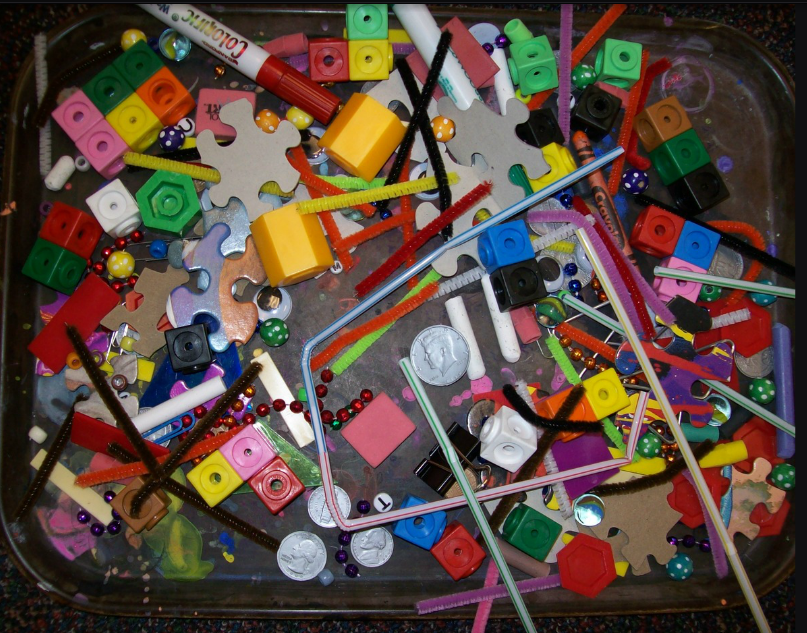
Here is a learning experience that after further review I feel as if it had very little educational value. I'm pointing the finger (index finger) at myself. In defense of this activity I was working in a rather low functioning special education classroom with students who were emerging readers and had more challenges than many other students their age.

I created an "I spy" learning adventure. We borrowed brown trays from the cafeteria. We borrowed many objects from the art room and we included numbers, letters, blocks, pencils, pens, paperclips and a multitude of other objects. Some of the objects were just distractors. Other objects were somewhat educational. For example: The number eight, in this picture, was used to be an object so that other people could find it on a webpage. One's ability to identify a number is relatively important and slightly involves math.

Did this lesson fit the New York state standards for math or art? I'm sure I could find a way for it to somehow fit into the state standards. Regardless, I just feel that this activity has very little educational merit. On the blooms taxonomy I would say that this is very low level. It is just identifying and recall. I won't even talk about how this lesson would be impossible to differentiate for a person with a visual impairment. (By the way, assistive technology is on of my niches and an issue very important to me).

I have a little rule. If you can Google the answer it's probably on the lower level of Blooms' taxonomy. The upper level of Blooms has to do with activities like design, create and teach. These upper level actives are not used today enough in modern K-12 education.

My whole point of this blog post is not to criticize my past teaching and learning. It is more to be an example of having a growth mindset and being reflective. I think it's important for every educator to look at what they've done in the past and see if it was good. Was what you did last year something you should do again this year? Maybe, there is something that you've done every year that was, upon further reflection, of little educational value. If it is of little educational value, and we know teachers are asked to do more and more with less and less, is it possible that some of these "legacy activities" are taking away valuable learning time that could be used for more educationally significant activities. Even the artist sets aside the brush, takes a step back and asked his/her self "what needs to be done next and was what I did previously something I should keep doing." In many ways, teachers are artists.

Sunday, March 27, 2016

Good is hard and Teacher’s Aides Make Classrooms Better

Good is hard and Teacher’s Aides Make Classrooms Better


I've been try to contribute to my blog every week. It has not been working, which is to say I missed a couple entries and have actually fallen off to every other week. This is not to say I don't write a lot. I do write quite a bit.


The trouble I'm having right now is the depth of my writing. To write something that matters, has a bite to it or offers some kind of insight is difficult. Blogs have evolved from online diaries to respected journalism resources. Scholarly writing takes cognitive work. I feel I am creative but sometimes I find it difficult for me to say original stuff. I'm sure others feel this way.


Thoughts about the worthiness of technology integration and there multiple matrices fictitiously categorizing a teacher’s use of digital resources has me ruminating. I'm working on conjuring up a blog post focusing on these thoughts. I'm not there yet.


Today I worked in a friend's school. Katie MacFarland, the Director of Curriculum and Instruction at Canandaigua schools, cross contracted to have me provide professional development. The training was very low level and the paraprofessionals who work in the school rarely have professional development focused on their learning. I also think it is safe to say that there were many hesitant technology users in both groups I worked with.


I was hesitant as well. It is Good Friday and in Canandaigua's case the last day of work before vacation. These educators were not attending my workshop voluntarily but they were getting paid. These situations, although not ideal, happen and I know my colleagues throughout experience similar situations.


This was a great day. There were ups and downs. One of the downs occurred when I said "is it possible that you accidentally deleted your Google Doc." Instantaneously, a sheepish look came across this young ladies face while simultaneously pointing the finger at her friend who was helping her." I defused with zen-like comments about togetherness uttered in dulcet tones. The ups for today were all the smiling faces who thanked me and said they learned a lot.

I had a teacher's aide in my alternative education classroom. Darla Havens made my class better and I'm not sure I could have done it without her. I probably appreciate her more than she knows. Many teacher's aides have the same kind-hearted, compassion, and eager to please attitude as Darla Havens. Never forget about your teacher's aides or paraprofessionals. And if you are a teacher's aide or paraprofessional we appreciate you. You make our good classrooms better. Thank you.

Sunday, March 6, 2016

What is Twitter?

I'm still shocked at the amount of educators who do not use Twitter to learn. It seems like some teachers actively avoid Twitter because, I think, they are afraid that it will suck up their time, which we all know is already extremely limited. Twitter has helped me learn, helped promote what I do and has helped to inspire me to keep learning. If you don't know what Twitter is there is a part of me that wants to say "that's ok." There is another part of me that wants to recommend that you find a real estate agent to help you move from under the rock that you live.
Twitter is a micro-blogging site that allows users to converse with large or small audiences with a text message-type blurb in a 140 characters or fewer.  Messages or “tweets” can be sent via text message, from a regular computer or a mobile device, any mobile phone.  There are also a bunch of third-party Twitter applications that allow users to create time-delayed tweets, organize tweets into search-able columns by topic or rank tweets by popularity worldwide. People can also discover what is trending, or popular on Twitter, by checking out "moments."
The experience on Twitter really depends on how many people “follow” you and your tweets and who you follow.  Some people find that the people that they follow have nothing but negative things to say.  Others say that they find out information from Twitter that either mainstream media has not cover yet or will not cover because mainstream outlets do not find it important.  
Still others use Twitter as a tool for social justice and helping to cause positive change in the world by communicating ideas and beliefs that benefit people.  During the massive and destructive earthquake in Haiti, a plane from the program Doctors without Borders was attempting to land in Port-au-Prince.  The plane, filled with critical life-saving supplies, was unable to land due to the U.S. Air Force having taken over the airport.  People from all over the world started tweeting to the U.S. Air Force’s Twitter feed and an hour later the plane was able to land.  At one point the U.S. Air Force tweeted back and said they were working on it.
What can Twitter do for students?  Like any type of communication tool, Twitter can be used for negative as well as positive.  One negative use was reported by KNWA, which is a Television Channel from North Western Arkansas.  Three teenage girls were “picked up” for bullying a fellow teen on Twitter. The student who was bullied did not return to school for 3 days because her self-esteem had been so damaged.  
Other students had their self-esteem affected in a positive way.  Oscar Lozoria, a shy 14-year-old student from East Los Angeles, said that after tweeting in his high school social studies class, his fellow students no longer made fun of him.  Oscar goes on to say that he is respected by his peers for his thoughts that his classmates see in the form of tweets.  Oscar said that, “They see me as somebody now, like an equal.”
No matter how you view Twitter, it is important to know about.  Whether you are sending out tweets about how many pancakes you ate for breakfast or are receiving tweets from authors who have written books you are reading in class, this type of communication is something to be aware of and is not going away anytime soon.